
JC Cutoffs & L1R4: A Data-Driven Guide for the 2028 JC Intake
What exactly is changing for JC admissions in 2028?
For decades, the L1R5 score has been the benchmark for JC admission. Starting with the 2028 JC intake, this will change. The Ministry of Education (MOE) is replacing the L1R5 system (one language and five relevant subjects) with an L1R4 system (one language and four relevant subjects). This major shift directly impacts the current cohort of lower secondary students who will be the first to sit for the new Singapore-Cambridge Secondary Education Certificate (SEC) examinations in 2027.
Under the new rules:
Qualifying score: Students will need to achieve an L1R4 score of 16 points or fewer to be eligible for JC admission.
Affected cohort: This applies to students who were in secondary 3 in 2026 and onwards.
This isn't just a simple calculation change. It signals a fundamental shift in educational philosophy, encouraging deeper learning over a broader range of subjects.
How should we rethink subject load for the L1R4 era?
The immediate question for parents and students is: should my child still take seven or eight subjects in upper secondary? Previously, taking more subjects provided a safety net. A weaker grade in one could be replaced by a stronger one. With L1R4, the calculation changes, making depth more important than breadth.
The pressure on each of the five core subjects used for scoring becomes immense. A single B4, which might have been manageable under L1R5, could be far more damaging to a student’s chances of entering a competitive JC. This pressure is most acute in subjects with steep learning curves, where concepts build upon each other. We see this often in topics covered by secondary 3 Mathematics tuition or secondary 3 Chemistry tuition, where a shaky foundation can quickly lead to bigger problems.
Managing this requires more than just late-night revision. It demands a deep, strategic understanding of core concepts. Expert-led coaching, like that found in structured secondary tuition programmes, helps students master these crucial subjects by identifying weak spots and building exam confidence long before the final papers. It helps shift the focus from merely covering the syllabus to truly understanding it.
Do past JC cut-off points predict future L1R4 competition?
While we don't have L1R4 data yet, we can analyse historical L1R5 trends to understand the competitive landscape. The 2026 Joint Admissions Exercise (JAE) saw cut-off points for many JCs become more stringent, indicating heightened competition. For instance, top-tier colleges saw their Science stream cut-offs holding at extremely low scores.
Here’s a look at the L1R5 cut-off points for a few JCs in recent years to illustrate the trend:
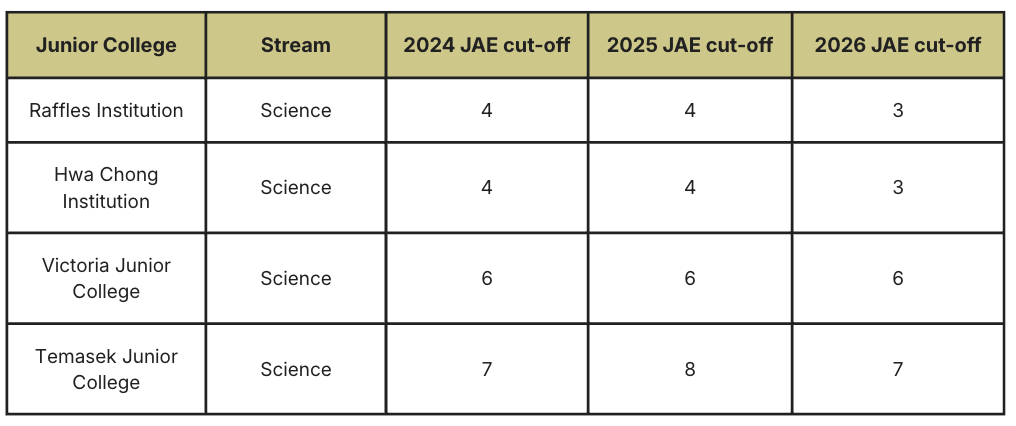
The key takeaway is that competition is already fierce. Under L1R4, with a smaller pool of subjects contributing to the score, the margin for error shrinks even further. An L1R4 score of 4 or 5 might well become the new benchmark for the most competitive programmes.
Your strategy for the 2028 JC intake
With these changes on the horizon, how can you and your child prepare effectively? The old strategies need updating. Here is a simple, actionable plan:
Prioritise core subject mastery: The focus must be on securing A1s and A2s in the subjects that will form the L1R4 score. This starts with building a rock-solid foundation, even from the lower secondary Science tuition level, ensuring no conceptual gaps are carried forward. A strong grasp of fundamentals in subjects like Mathematics and the Sciences is non-negotiable.
Choose your 'buffer' subjects wisely: Taking six or seven subjects is still a sensible strategy. The extra subjects can be used as a replacement if one of the core subjects doesn't go as planned. However, the choice should be strategic, focusing on subjects where the student has a high aptitude or genuine interest to maximise the chance of a good grade without overstretching their workload. Consider options like online secondary tuition to manage time effectively.
Stay informed on SEC banding: The new SEC examinations will feature three subject levels (G1, G2, G3). Understand how these levels translate to JC admission criteria as MOE releases more details. This will be crucial for making informed subject choices.
Final thoughts: A shift towards depth
The move to L1R4 is more than a policy tweak. It’s a re-calibration of what academic success looks like. It encourages students to build a deeper, more resilient understanding of fewer subjects, a skill that is invaluable for the rigours of the "A" Level curriculum and beyond. For parents and students, this means adopting a new mindset focused on mastery, strategic choices, and consistent effort.
As you navigate this new landscape, finding the right support is key. To understand how structured learning can help your child master their core subjects, learn more about our approach to secondary Mathematics tuition and other key subjects.

Image Credit: Kaboom Pics
Frequently asked questions
When does the L1R5 to L1R4 change for JC admission start?
The transition from the L1R5 to the L1R4 scoring system for MOE JC admission begins with the 2028 JC intake. This change impacts students who were in Secondary 3 from 2025 onwards.
What is the qualifying score for JC admission under the new L1R4 system?
To be eligible for JC admission under the new L1R4 system, students must achieve a score of 16 points or fewer. This system replaces the previous L1R5 benchmark that was used for decades.
Does the move to L1R4 mean I should take fewer subjects for my Sec 3 subject combination?
Taking six or seven subjects is still a sensible strategy for many students despite the shift to L1R4. These extra subjects provide a safety net by allowing students to replace a lower grade in a core subject with a better grade from an additional one, provided the subjects are chosen strategically based on student aptitude.
How can secondary tuition in Singapore help with the shift to L1R4?
Structured secondary tuition in Singapore helps students identify weak spots and master core concepts early. This is critical because the L1R4 system allows for less margin of error. Consistent support in areas such as secondary math tuition or sec 3 chemistry tuition can prevent small conceptual gaps from compounding into larger problems that impact a student final aggregate score.
Will the new L1R4 system affect JC cutoff points?
The competition for JC places will remain intense under the new system as the calculation change means that a single grade lower than an A1 or A2 significantly impacts the overall L1R4 score. While we lack direct L1R4 data, students should anticipate that JC cutoff points will continue to reflect a highly competitive environment where mastery of core subjects is essential for admission.

Find the Right Learning Support at Every Stage
Building strong study habits takes patience, especially when academic demands pick up. If your child needs an extra hand making difficult topics click, Geniebook offers targeted support across every stage. Find AI-personalised worksheets and live classes for primary and secondary school at Geniebook, comprehensive secondary, IB and JC subject tuition at AfterSkool or dedicated physics masterclasses at Tuition Physics and Best Physics Tuition.