
A-Level Physics 2027: A Guide to What Markers Look For in Problem-Solving
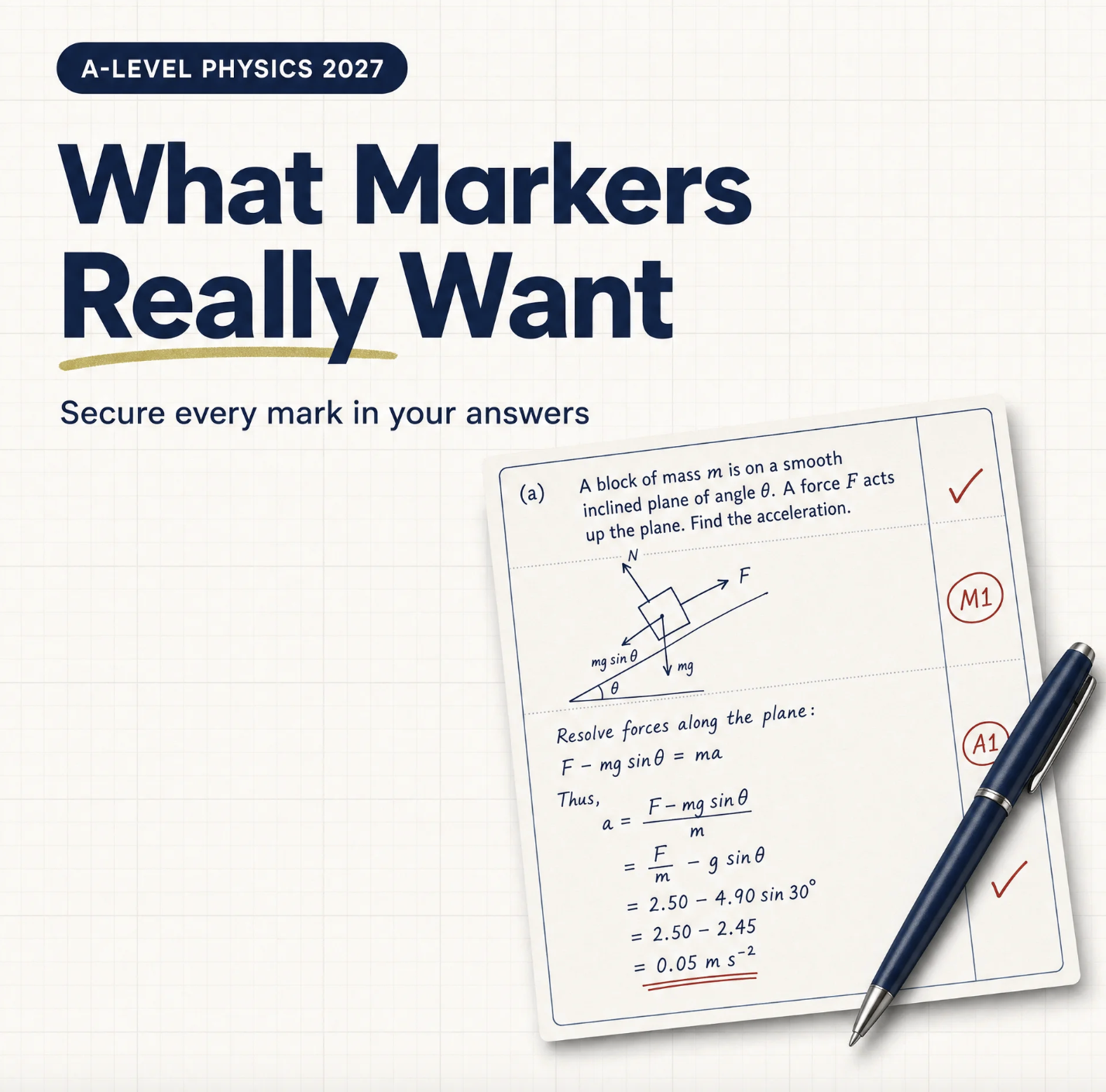
What does a "perfect" physics answer look like to an examiner?
For the upcoming 2027 "A" Level Physics paper, SEAB and Cambridge examiners are looking for evidence of thinking, not just memorisation. A student who simply recalls a formula and plugs in numbers might get some credit, but the top marks are reserved for those who demonstrate a deep, structured understanding of the physics involved. Quality JC physics tuition focuses on instilling these habits.
High-scoring answers consistently exhibit these five traits:
Clear reasoning and a logical path: The solution reads like a story. It starts by identifying the physical principle at play (e.g. conservation of momentum, Kirchhoff's laws) and progresses step-by-step to the final answer. Multi-step problems are broken down into manageable parts.
Correct application of principles: It’s not about knowing the formula sheet. It’s about understanding when to use a specific equation and why it applies to a novel situation. This is what separates rote learners from true physicists.
Precise technical language: Marks are awarded for using the right keywords. The best answers often follow a clean structure: Claim (a statement of physics using keywords) → Equation → Substitution → Final Answer with units.
Meticulous accuracy: Carelessness costs marks. Examiners expect correct units, appropriate use of standard form and answers given to the correct number of significant figures. This shows scientific rigour.
Full working shown: Every step of a calculation must be documented. Method marks are crucial, and showing your work provides a safety net if a final calculation error occurs. It also proves your logical process.
Image Credit: Yan Krukau
Why do good students still lose marks in physics?
Many bright students face a frustrating plateau. They understand the content but lose marks in the exam hall. The primary reason is a reliance on what some educators call the 'content ingestion and regurgitation' model of learning. Students memorise facts and solutions but haven't developed the analytical mindset to solve unfamiliar problems.
This is where the hardest marks are lost. A student can check their work against a mark scheme and see the 'correct' answer without truly understanding the flaw in their own logical approach. Identifying the root cause of a lost mark (a conceptual error, a misinterpretation of the question or a simple calculation mistake) is a skill in itself. Without consistent, expert feedback, these mistakes can become ingrained habits. This is often where structured guidance from a good jc tuition programme makes a tangible difference, as an experienced tutor can spot these recurring logical gaps that a student might repeatedly miss.
How can students practice smarter for the 2027 "A" Levels?
To move beyond simple memorisation, students need to adopt an active problem-solving approach. Revision should start with practice, not just reading notes.
Drill exam technique actively: Work through past "A" Level papers under timed conditions. More importantly, analyse every single lost mark against the official mark scheme. This process reveals the specific expectations of examiners.
Build a 'physics phrasebook': As you review mark schemes, create a personal notebook of recurring keywords and precise definitions. This aligns your own scientific vocabulary with what markers are trained to reward.
Target high-value topics: Some topics carry more weight. Dedicate focused practice time to areas like Fields, Simple Harmonic Motion (SHM) and Electricity, which often feature in multi-step, high-mark questions. Much like with H2 chemistry tuition, mastering the fundamentals of key areas pays dividends across the entire paper.
Image Credit: Andy Barbour
Is AI a shortcut to an 'A' grade? The surprising reality
With AI tools like ChatGPT becoming more common, some students might be tempted to use them for homework or to solve problems. This is a significant risk. A recent analysis highlighted by Channel NewsAsia showed a physics paper completed using AI received a failing grade of just 18.5 out of 75 marks. The AI-generated answers were often vague, lacked proper working and failed to provide the specific details examiners require.
The "A" Levels are designed to test your analytical and problem-solving skills. While AI can be useful for generating ideas or checking grammar, relying on it for solutions undermines the very skills the exam is designed to assess. It prevents the development of a genuine physicist's mindset, which is the ultimate goal.
Beyond the exam hall: Why H2 physics skills matter in an AI-driven world
There's a reason H2 Physics is a respected qualification. Approximately 40% of the paper requires the application of mathematical skills, fostering a high level of numeracy and analytical thinking. These are precisely the 'meta-skills' that are becoming more valuable in an economy increasingly shaped by AI.
The ability to learn, adapt and solve complex problems is what sets human intelligence apart. Singapore’s consistent success in competitions like the International Physics Olympiad and the International Young Physicists Tournament is built on this foundation of rigorous analytical training. "A" Level Physics is not just about learning facts. It's about learning how to think.
Securing success in "A" Level Physics
For students aiming for distinction in the 2027 "A" Levels, the message is clear: focus on mastering the problem-solving process. This means moving away from passive revision and towards active, structured practice that is ruthlessly checked against examiner standards. It’s about building the intellectual habits of a physicist, a skill that will serve them long after they leave the examination hall.
Parents and students looking for guidance on developing these exam techniques can explore specialised secondary, JC and IB tuition programmes for more support.
Frequently asked questions
What are examiners looking for in a good A-Level H2 Physics answer?
Examiners are looking for answers that show deep, structured thinking and clear reasoning, not just the memorisation of formulas. High-scoring answers for the A-Level H2 Physics paper consistently identify the correct physical principles, use precise technical language, show full working with meticulous accuracy and present a logical step-by-step solution. This approach is often a focus of quality jc physics tuition programmes.
Why do good students lose marks in JC physics exams?
Good students often lose marks in JC physics because they rely on memorising content and solutions instead of developing the analytical mindset needed to solve unfamiliar problems. This 'content ingestion and regurgitation' approach means students may not understand the root cause of their errors, such as a conceptual mistake or misinterpreting the question. Without expert feedback, like that from a physics jc tuition tutor, these logical gaps can become ingrained habits.
How can I improve my problem-solving skills for H2 Physics?
To improve your H2 Physics problem-solving skills, you should move from passive revision to active practice using past exam papers under timed conditions. Actively analyse every lost mark against the official mark scheme to understand examiner expectations. It is also helpful to build a personal 'phrasebook' of key scientific terms and definitions that markers reward and to focus practice on high-value topics like Fields, SHM and Electricity, a strategy often taught in h2 physics tuition.
Is it a good idea to use AI like ChatGPT for A-Level Physics homework?
No, it is a significant risk to rely on AI tools like ChatGPT for A-Level Physics as they often produce vague or incorrect answers and undermine the development of your own analytical skills. The article highlights an analysis where an AI-completed physics paper received a failing grade because the answers lacked proper working and specific details. The A-Levels are designed to test your personal problem-solving abilities, which is the ultimate goal of subjects like H2 Physics, H2 Chemistry tuition and H2 Maths tuition.
What skills does H2 Physics develop that are useful in an AI-driven world?
H2 Physics develops a high level of numeracy and analytical thinking, which are valuable 'meta-skills' that set human intelligence apart from AI. With a significant portion of the paper requiring the application of mathematical skills, the subject fosters the ability to learn, adapt and solve complex problems. This rigorous analytical training, which is a key part of the Singapore education system, prepares students for the future economy long after they finish their JC tuition.
Master Physics with our star tutor Ben, with over 12 years of teaching experience!
Find the Right Learning Support at Every Stage
Building strong study habits takes patience, especially when academic demands pick up. If your child needs an extra hand making difficult topics click, Geniebook offers targeted support across every stage. Find AI-personalised worksheets and live classes for primary and secondary school at Geniebook, comprehensive secondary, IB and JC subject tuition at AfterSkool or dedicated physics masterclasses at Tuition Physics and Best Physics Tuition.