
A Math vs E Math: A 2027 Guide to Time Per Question Breakdown
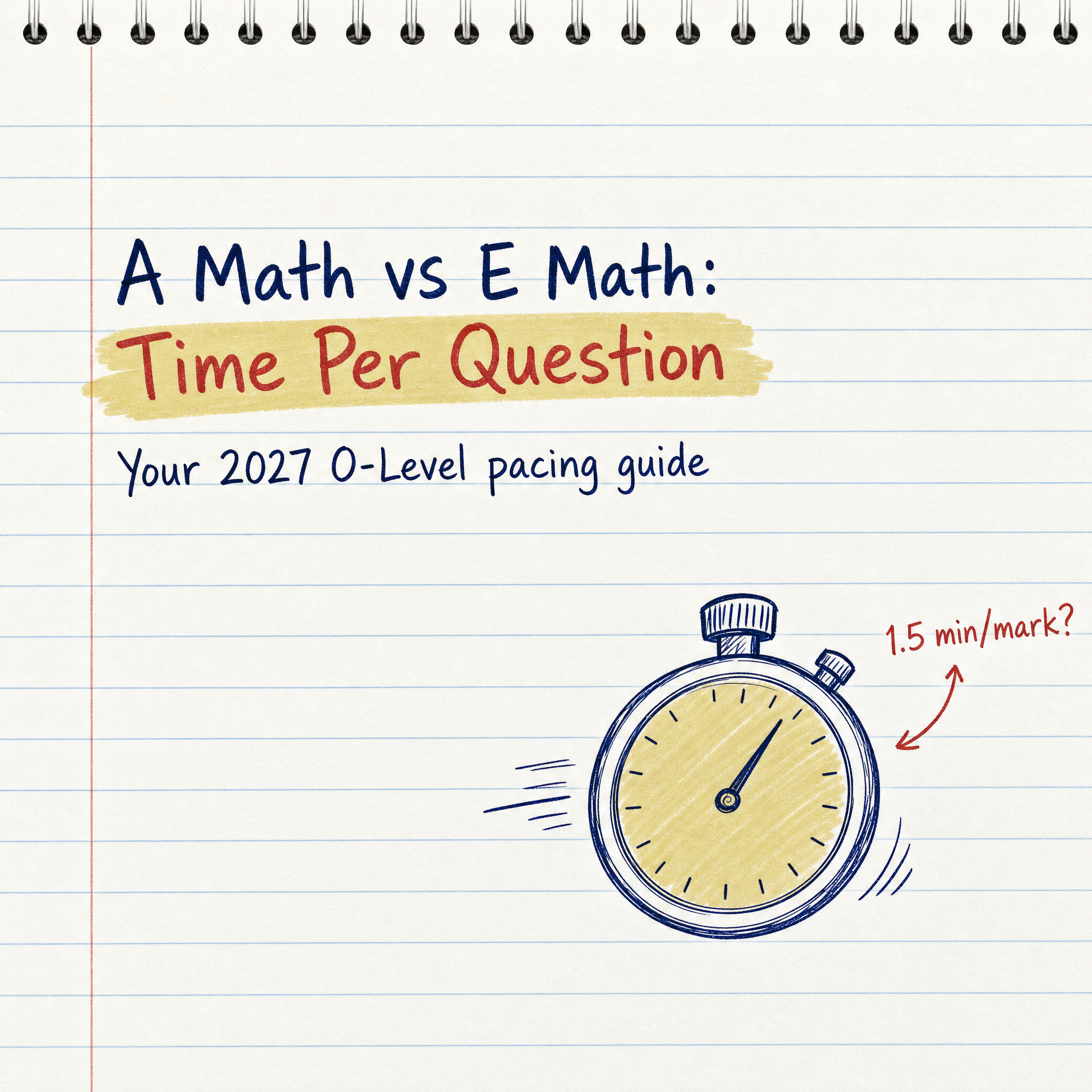
A. Maths vs E. Maths: a 2027 guide to time per question breakdown
For the upcoming 2027 "O" Level Mathematics examinations, the most common question I hear from anxious parents and students is about pacing. The simple answer is to allocate about 1.5 minutes for every mark, since both the E. Maths and A. Maths papers are 2 hours and 15 minutes (135 minutes) for 90 marks. However, treating every question equally is a critical error that can cap a student's grade.
The reality is that exam papers are designed with a mix of difficulties. A better strategy involves banking time from straightforward questions to spend on more complex, multi-step problems. This approach to managing time per question is the single most important exam skill beyond content mastery.
Image Credit: Ninh Van Son
Why averaging your time per mark is a trap
Thinking about exam timing as a flat average is a common pitfall. An exam paper is not a uniform sprint. It is a strategic race with varied terrain. The Ministry of Education (MOE) has confirmed a similar principle for the PSLE, capping the most challenging questions at around 15% to reliably differentiate top performers. The "O" Level papers, including the new syllabus (coded K310 from 2027), follow a similar design philosophy.
This means some questions are intentionally designed to be solved in under a minute, while others might justifiably take 5-7 minutes. Students who spend a rigid 3 minutes on a 2-mark question they could have solved in 45 seconds are losing the precious time they will desperately need for the harder, high-value problems at the end of the paper.
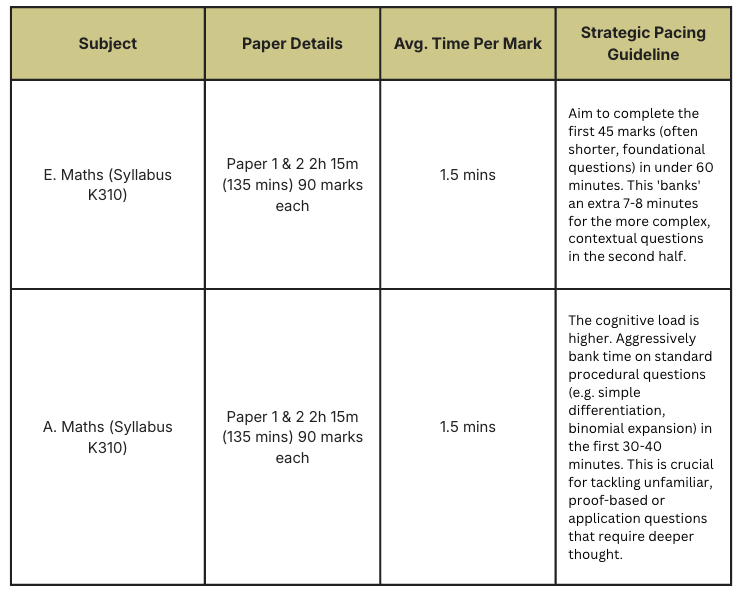
Recommended time allocation for 2027 "O" Level Maths
Instead of a flat average, a structured pacing plan is more effective. Here is a practical breakdown for students taking their secondary 4 Maths tuition seriously and aiming for distinction.
How can your child master exam pacing?
Mastering time management is an active skill that requires deliberate practice. It won't happen automatically just by doing more assessment books. Here are three field-tested strategies we use in our programmes.
The 'Three-Pass' Method: On the first pass, answer only the questions you are completely confident in. On the second pass, tackle the questions you know how to do but require more steps. The final pass is for the most difficult questions that you left blank. This ensures all achievable marks are secured first.
The 5-Question Check-in: Borrowing a strategy from the Digital SAT, students should quickly check the clock after every 5 questions. This creates regular checkpoints to assess if they are on track, ahead or falling behind their plan, allowing for micro-adjustments instead of a frantic rush at the end.
Create a 'Timing Error' Log: Go beyond marking answers as right or wrong. Create a log to categorise mistakes, especially those related to time: 'Careless error due to rushing', 'Ran out of time' or 'Spent too long on this question type'. Over time, a clear pattern of weakness will emerge.
Identifying these patterns is the first step, but breaking the habit can be frustratingly difficult alone. A student might see they always get stuck on trigonometry proofs, but not know how to get faster without expert feedback. This is a common challenge where structured secondary Maths tuition can provide the targeted, timed practices and diagnostic analysis needed to turn weaknesses into strengths.
Is this different for IP or secondary 3 students?
Absolutely not. These pacing principles are universal. For a student in secondary 3 Maths tuition, this is the perfect year to build these habits before the pressure of the national exams begins. For IP students, the stakes are their crucial school-based promotional exams, which are often just as demanding. Developing a strategic approach to time management early on is one of the most significant predictors of success in upper secondary and beyond.
Image Credit: George Pak
Building confidence beyond the clock
Ultimately, managing time effectively is about building confidence. When a student has a clear strategy for the paper, they are less likely to panic when faced with a difficult question. They know they have banked time, they have a system to follow and they can maintain control. This psychological edge is often as important as content knowledge.
If you feel your child could benefit from a more structured approach to exam preparation, you can find out more about our secondary, JC and IB tuition programmes.
Frequently asked questions
How much time should I spend per mark for the 2027 O-level maths exam?
The recommended average time for the 2027 O-Level Maths exam is 1.5 minutes per mark, as each paper is 135 minutes long for 90 marks. However, a superior strategy is to bank time from easier questions to use on more difficult ones rather than applying this average rigidly to every single question.
Why is simply averaging my time per question a bad idea for A Math?
Simply averaging your time per question is a bad strategy for A. Math because papers contain a deliberate mix of easy and difficult questions. Spending a fixed amount of time on a simple question wastes precious minutes that are essential for solving the more complex high-mark problems that require deeper thought, a common challenge addressed in A. Math tuition.
What is a better pacing strategy for the O-level E Math paper?
A better pacing strategy for the O-Level E. Math paper is to aim to complete the first 45 marks in under 60 minutes. This approach banks extra time, about 7 to 8 minutes, which can then be spent on the more difficult contextual questions typically found in the second half of the paper, a key skill often taught in E. Math tuition programmes.
When is the best time to start practising exam time management for maths?
The best time for a student to start practising exam time management is in Secondary 3. Building these pacing habits during Sec 3 is ideal as it allows them to master the strategy before the high-pressure environment of the Secondary 4 national examinations, making it a crucial focus for any math secondary tuition.
What is syllabus K310 for O-level maths?
Syllabus K310 is the new syllabus code for the GCE O-Level Elementary and Additional Mathematics examinations for the 2027 cohort and beyond. Both the E. Maths and A. Maths papers will be based on this updated syllabus which maintains the 90-mark 2-hour-and-15-minute paper format.
Find the Right Learning Support at Every Stage
Building strong study habits takes patience, especially when academic demands pick up. If your child needs an extra hand making difficult topics click, Geniebook offers targeted support across every stage. Find AI-personalised worksheets and live classes for primary and secondary school at Geniebook, comprehensive secondary, IB and JC subject tuition at AfterSkool or dedicated physics masterclasses at Tuition Physics and Best Physics Tuition.