
Singapore Post-Secondary Admissions 2028: What Is PSE and How It Affects JC, Poly and ITE

Singapore’s Ministry of Education (MOE) is rolling out major changes to the way students apply to junior colleges (JC), polytechnics and the Institute of Technical Education (ITE) after secondary school.
From 2028, students will no longer have to navigate several different admissions exercises such as the Joint Admissions Exercise (JAE) or the Joint Intake Exercise (JIE). Instead, all applications will be consolidated into a single system called the Post-Secondary Admissions Exercise (PSE), simplifying the process for all students.
At the same time, familiar exams like the O-Levels and N-Levels will be phased out and replaced by a new national qualification known as the Singapore-Cambridge Secondary Education Certificate (SEC).
These changes are part of Singapore’s transition to Full Subject-Based Banding (FSBB), which allows students to take subjects at different levels based on their strengths instead of being fixed in a single academic stream. In short, the system becomes simpler to navigate, but more dependent on students making thoughtful and informed choices.
For students and parents, these changes may feel daunting at first, but the goal of the new system is to give students more flexibility to explore their strengths, rather than be defined by a single pathway early on.
For those of us who grew up feeling the pressure of choosing the “right stream”, this shift provides reassurance to a new generation: students’ strengths don’t have to fit neatly into a single box anymore.
What Is Changing in Singapore’s Post-Secondary Admissions System (PSE)?
Below is a clear breakdown of what is changing and what it means.
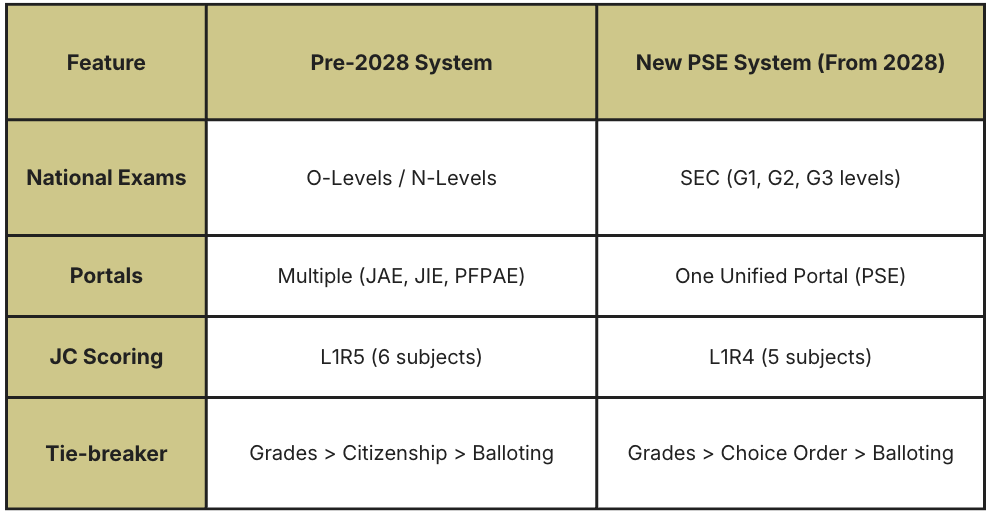
How the New Singapore Post-Secondary Admissions System (PSE) Works
1. A new national exam will replace O-Levels and N-Levels
From 2027, all students will take a single national exam called the Singapore-Cambridge Secondary Education Certificate (SEC), replacing the O-Levels and N-Levels.
Under this system:
• Students will take each subject at different levels of difficulty, known as G1, G2 or G3.
• Their certificate will show the subjects they took and the level for each subject.
• The exam will continue to be jointly administered by the Singapore Examinations and Assessment Board (SEAB), the Ministry of Education (MOE) and Cambridge International Education.
Importantly, standards and international recognition are expected to remain unchanged.
2. All students will apply through one admissions exercise
From 2028, all students will apply through a single admissions process called the Post-Secondary Admissions Exercise (PSE).
Currently, secondary school students apply to post-secondary institutions through several different admissions exercises, depending on their academic stream.
For instance:
• Express students typically apply through the Joint Admissions Exercise (JAE).
• Normal (Academic) students may apply through exercises such as the Polytechnic Foundation Programme Admissions Exercise (PFPAE) or the Joint Intake Exercise (JIE).
• Normal (Technical) students apply through other JIE pathways.
As a result, students today often have to navigate different portals, timelines and procedures.
The new PSE removes this complexity by bringing all applications into one unified system.
Students will use their SEC results to apply to:
Junior Colleges (JC)
Millennia Institute (MI)
Polytechnics
Institute of Technical Education (ITE)
3. Students can choose up to 12 options
Students can list up to 12 course or school choices in order of preference under the new system.These choices can include any combination of JC, MI, polytechnic or ITE courses that they are eligible for.
4. Choice order will now matter
The order of choices will directly affect admission outcomes under the new system.
If two students have the same results, tie-breakers will be applied in the following order:
Citizenship
Choice order
Gross aggregate score
Computerised balloting
This means students should rank options based on genuine interest, not just perceived prestige.
5. Applications will take place over a six-day window
The PSE application window will last about six days immediately after results release.
The timeline for the new admissions process will look like this:
Mid-January
SEC results released.
Mid-January (same week)
PSE application portal opens for six days.
Students submit up to 12 ranked choices through a Singpass-accessible portal.
By early February
Posting results released.
Next school day
Students posted to JC or MI report to their schools.
April
Students posted to polytechnics or ITE begin their courses.
6. Early admissions routes will still exist, and they start much earlier
Early admissions pathways such as DSA and EAE will remain, but require significantly earlier preparation.
Admissions pathways that consider talent and interests beyond grades will remain available. These include schemes such as the Direct School Admission, the Polytechnic Early Admissions Exercise, and the ITE Early Admissions Exercise.
However, families should note that these pathways begin months before the national examinations.
For example, DSA applications typically open around May or June, with outcomes often confirmed before final exams.
This means students who hope to apply through DSA should ideally begin preparing at least a year earlier—for instance by building a portfolio, participating in competitions, or developing achievements in areas such as sports, leadership, performing arts or specialised academic fields.
In practice, preparation often begins as early as Secondary 3.
7. Another change to note: Language papers will move earlier in the exam calendar
From 2027, English and Mother Tongue written papers will be held earlier, typically in September.
Previously, language papers were taken during the same exam period as other O-Level subjects. Under the new structure, moving them earlier helps spread out students’ exam load.
Additionally, Mother Tongue written papers will only be held once each year. While the schedule changes, the exam format and standards are expected to remain largely the same.
What Do These Changes Mean for Students and Parents?

Image Credit: ThisIsEngineering
Subject choices may carry new strategic implications
Subject combinations will become more important under Full Subject-Based Banding (FSBB).
The move to FSBB means students will increasingly take subjects at different levels depending on their strengths.
Under the new system, the Singapore-Cambridge Secondary Education Certificate will reflect both the subjects taken and their respective levels.
This mixed subject profile will directly influence admissions outcomes.
Another notable change is how admission scores will be calculated. Junior colleges and Millennia Institute will move to the same L1R4 aggregate scoring framework currently used for polytechnic admissions, instead of the traditional L1R5 system.
With fewer subjects counted, performance in key subjects may carry more weight than before.
For families considering different post-secondary pathways, this signals a broader shift: students can keep more options open for longer while exploring their strengths.
A simpler application process
Previously, students needed to navigate:
Multiple admissions exercises
Different portals
Several timelines
The new system simplifies this into a single, streamlined process:
One results release
One application window
One posting outcome
This reduces administrative complexity for both students and parents.
Students may need to plan earlier: Here’s a smart approach
Students should start exploring options earlier, rather than waiting until results release.
Because the order of choices can affect outcomes, the application process is no longer just administrative—it is strategic.
Think of the application as the final step of a longer decision-making journey.
In practical terms, this means:
Researching courses early
Speaking to teachers and seniors
Reflecting on personal strengths and interests
For example, a student who enjoys building may explore engineering pathways, while one who enjoys writing may consider the JC route.
Parents and schools also play an important role here. Conversations should focus on fit and growth, not just prestige.
The good news is that the new system does not demand perfect foresight. With up to 12 choices, students can balance ambition with realistic options.
In other words, start early, stay curious, and prioritise what genuinely interests you.
The bottom line on Singapore’s post-secondary admissions 2028 changes
Singapore’s new admissions system is designed to be simpler, but more student-driven.
By introducing:
a single national exam (SEC)
a single admissions exercise (PSE)
greater emphasis on student choice
The system shifts away from rigid academic pathways towards flexibility and personal strengths.
If you have queries, AfterSkool’s experienced educators are happy to consult!
For students and parents, the takeaway is clear: the process will be easier to navigate, but making informed, thoughtful choices will matter more than ever.

Image Credit: Katerina Holmes
Frequently Asked Questions (PSE Singapore)
What is the Post-Secondary Admissions Exercise (PSE)?
The Post-Secondary Admissions Exercise (PSE) is a new unified system starting in 2028 that allows all secondary school students in Singapore to apply to junior colleges, polytechnics, Millennia Institute, and ITE through a single application process.
What exam will replace the O-Levels and N-Levels?
The O-Levels and N-Levels will be replaced by the Singapore-Cambridge Secondary Education Certificate (SEC), a single national exam where students take subjects at different levels based on their strengths.
How many choices can students select under the new system?
Students can list up to 12 course or school choices in order of preference, including any combination of JC, MI, polytechnic, or ITE options they are eligible for.
Does the order of choices matter in the PSE?
Yes, the order of choices matters. If students have similar results, admission decisions may consider how highly a course was ranked, so students should prioritise options they genuinely prefer.
When will students apply for post-secondary schools under the new system?
Applications will take place over a six-day window in mid-January, immediately after the release of SEC results, with posting outcomes typically released by early February.
Will early admissions exercises like DSA and EAE still exist?
Yes, early admissions pathways such as Direct School Admission (DSA) and Early Admissions Exercises (EAE) will still be available, but they begin much earlier—often months before the national exams.
What is Full Subject-Based Banding (FSBB)?
Full Subject-Based Banding (FSBB) allows students to take subjects at different levels (G1, G2, G3) based on their strengths, instead of being placed in a fixed academic stream.
How will these changes affect students and parents?
The new system simplifies the application process but places greater emphasis on planning and choice. Students will need to think more carefully about subject combinations and how they rank their options.