
A Father’s Loss During the O-Level: How One Canoeist’s Resilience Redefines Success

Paddling through the unthinkable: what happens when crisis hits during the "O" Levels exam?
For most Singaporean students the GCE "O" Levels exam is a formidable rite of passage. But for national canoeist Jovi Jayden Kalaichelvan it coincided with a devastating personal tragedy. During his "O" Levels examination period his father passed away. This profound loss occurred while his younger brother was sitting for the PSLE and the family was also caring for an older brother with cerebral palsy. As his mother Ms. Sandhu shared the events brought their family to its knees.
Jovi’s story forces us to ask a difficult question: how can a teenager possibly cope with overwhelming grief while navigating the immense pressure of a national examination that will shape their future? His answer was found in the water in the rhythmic stroke of his paddle.

Image Credit: Roberto Sánchez
Can a CCA be more than just a distraction?
Many parents worry that demanding co-curricular activities will steal precious time from studying for crucial papers like “O" Levels Maths or "O" Levels Physics. Jovi's experience presents a powerful counter-narrative. Canoeing wasn't a distraction. It was his lifeline. His coach since the age of 14 Mr. Bill Lee emphasised that the sport demands daily training to build strength and endurance. This relentless routine provided Jovi with structure and a sense of purpose when his world was falling apart.
The discipline instilled through sport became a transferable skill. The mental fortitude required to push through physical pain on the water translated directly into the resilience needed to sit for his "O" Levels papers while grieving. It was this passion that anchored him and ultimately saw him represent Singapore at the SEA Games just a few years later winning a bronze medal.

Image Credit: Mikhail Nilov
How does this resilience affect "O" Levels scoring?
While Jovi’s story is exceptional the lesson it holds is universal. The pressure of the "O" Levels isn't just about mastering the syllabus for ten different subjects. It's a test of a student's emotional endurance mental organisation and ability to perform under stress. A high final "O" Levels result is often the product of this resilience as much as it is of academic revision.
But what happens when a child feels adrift without a strong internal anchor like Jovi's? The immense pressure of the GCE "O" Levels examination can be isolating especially during a personal crisis. This is often where a consistent external mentor can make a critical difference. Structured guidance can provide not just academic help but also a stable routine and a trusted adult to talk to. This kind of exam-focused coaching and feedback helps students stay on track when life feels overwhelming.
The road ahead: understanding the shift from GCE "O" Levels to SEC
The landscape of the "O" Levels is changing. While the need for resilience remains constant the structure of the examinations managed by SEAB is evolving. It is crucial for parents to understand these shifts especially for current lower secondary students.
Starting from the 2027 cohort the GCE "O" Levels and N-Levels will be replaced by the Singapore-Cambridge Secondary Education Certificate (SEC). Here’s a quick comparison of the key changes:
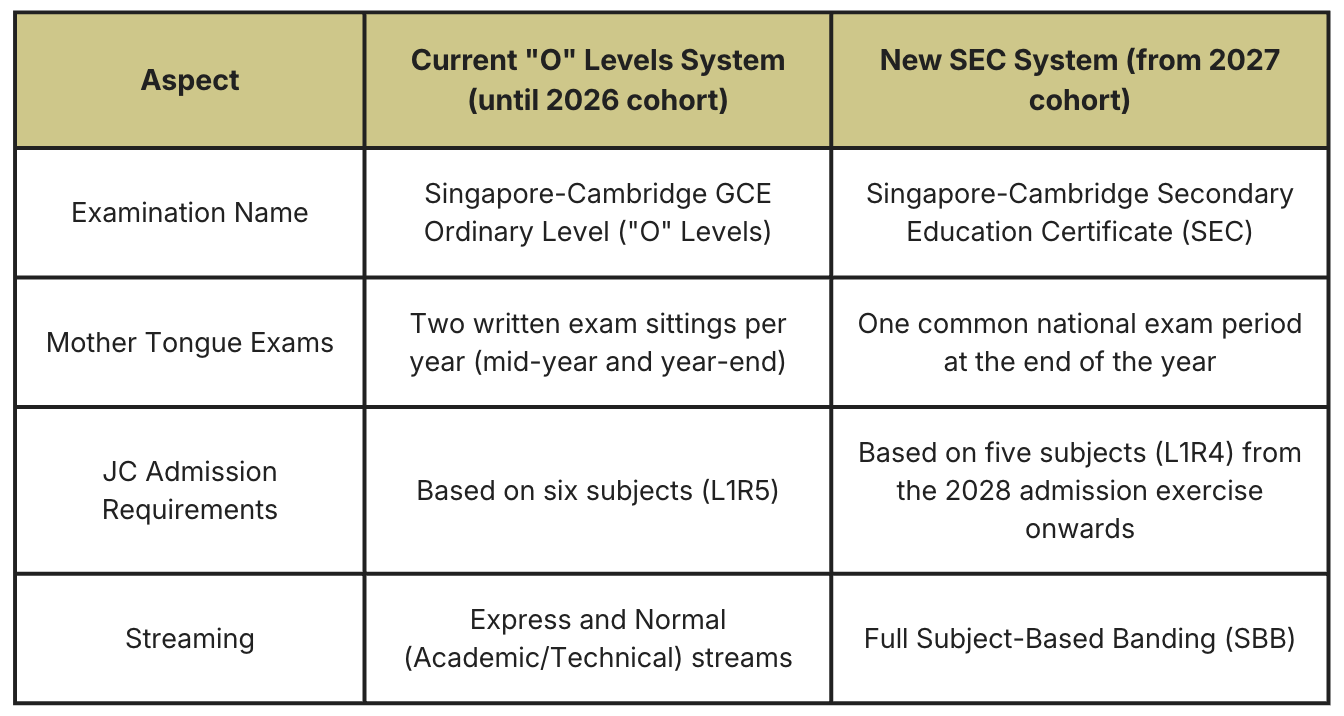
These changes aim to reduce academic load and provide more flexibility. However the final national exam will remain a significant milestone requiring the same dedication and mental strength.
Building character: your role in your child's "O" Levels journey
Jovi’s journey teaches us that preparing for the "O" Levels goes beyond assessment books and tuition. It’s about building a resilient person who can weather life’s storms. His passion for canoeing was not a liability to his "O" Levels cert it was the key to his survival and eventual success.
As your child navigates their secondary school years remember that their passions hobbies and interests are not frivolous distractions. They are the training grounds for developing the character and strength they will need for the "O" Levels exams and for life itself. Fostering these interests may be the most important preparation you can provide.
To learn more about how our secondary, JC and IB tuition programmes can support your child's academic and personal growth journey you can book a consultation with our education specialists.
Frequently asked questions
Should my child stop their CCA to focus on the o level exam?
A demanding CCA can actually be a lifeline for a student during the stressful o level exam period, rather than a distraction from studying. The article highlights how the discipline and routine from canoeing provided canoeist Jovi Jayden Kalaichelvan with structure and purpose, helping him build the mental fortitude needed to navigate both his exams and personal grief. Fostering a child's passion can be a key part of their preparation for the gce o level and for life.
How can students cope with stress during the gce o level examination?
Students can cope with stress during the gce o level examination by developing resilience and having a strong support system. For national canoeist Jovi, his sport provided a crucial anchor, but the article suggests that an external mentor or structured guidance can also provide a stable routine and academic help for students who feel overwhelmed. This kind of support helps students stay on track when facing personal crises or immense pressure.
What are the main changes from the GCE O-Level to the new SEC exam?
The main changes from the gce o level to the Singapore-Cambridge Secondary Education Certificate (SEC) involve a new examination name, a single national exam period for Mother Tongue and revised Junior College admission requirements based on five subjects (L1R4) instead of six (L1R5). This new system, managed by SEAB, will begin with the 2027 cohort and replaces the Express and Normal streaming with Full Subject-Based Banding (SBB).
How does mental strength affect the final o level result?
Mental strength and resilience can significantly affect a final o level result, as the national exam is a test of emotional endurance as much as it is of academic knowledge. The article explains that the ability to perform under stress and stay organised, especially when facing subjects like o level maths or o level physics, is a key factor in achieving a high o level scoring. This fortitude helps students navigate the pressure of mastering the syllabus for up to ten subjects.