
Forces & Motion: Newton's Laws Missteps Cost O-Level Marks | AfterSkool Physics Tuition
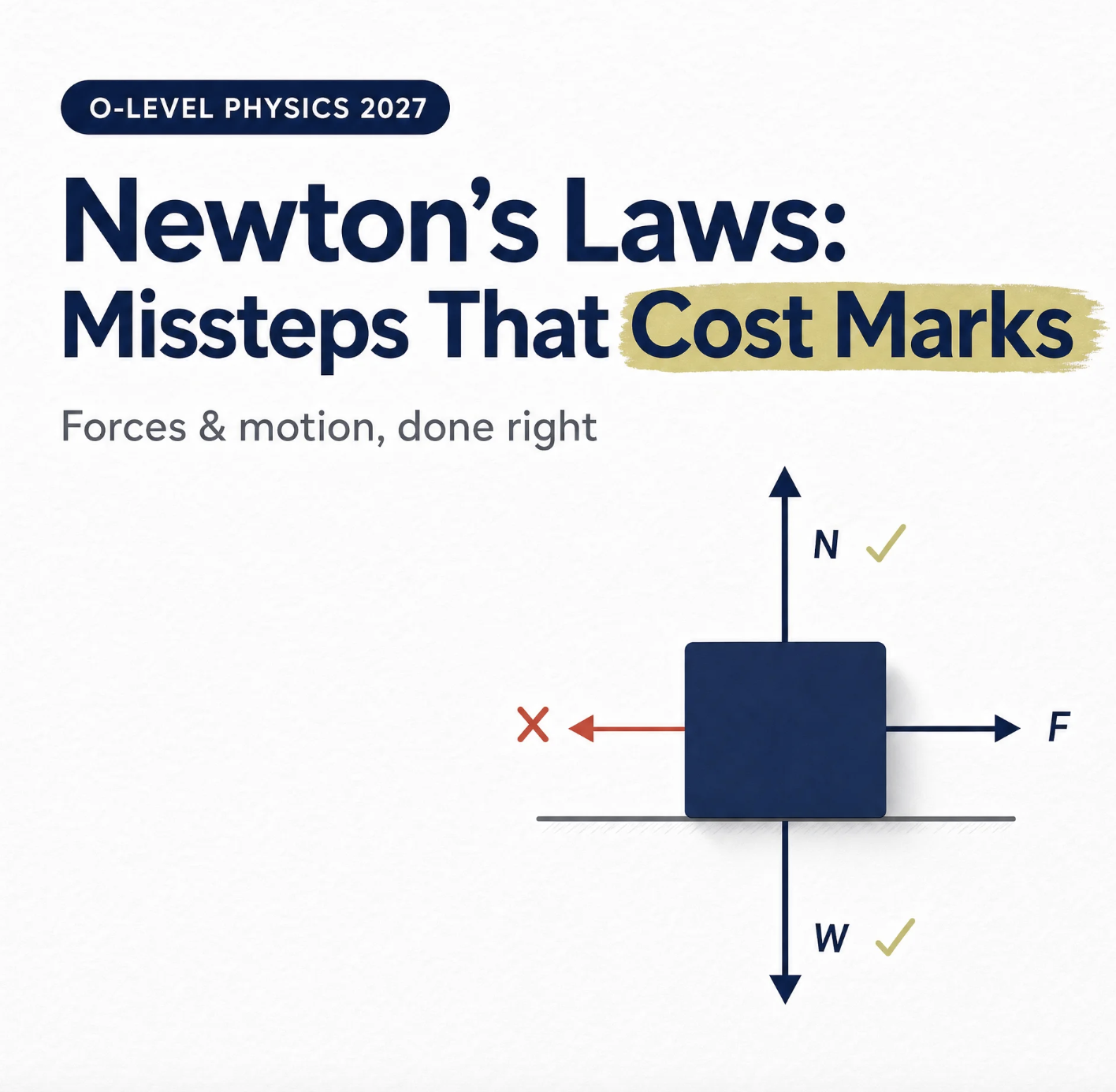
The "no resultant force" trap that catches even good students
One of the most common conceptual traps is using the phrases “no forces acting” and “no resultant force acting” interchangeably. They mean completely different things, and Cambridge examiners are known to test this distinction explicitly.
"No forces acting" means the object is in deep space, isolated from all gravitational pulls and contact forces. This is a theoretical ideal.
"No resultant force acting" means all the forces acting on the object are balanced and cancel each other out. The net effect is zero.
According to Newton's First Law, an object with no resultant force will either remain at rest or move at a constant velocity. A car driving at a steady 60 km/h has a forward thrust from the engine and opposing forces like air resistance and friction. Since the velocity is constant, the resultant force is zero. There are clearly forces acting on it, but they are balanced.
This confusion often extends to other key terms:
Mass vs. weight: Mass is the amount of matter in an object (in kg), while weight is the gravitational force acting on that mass (in Newtons). They are not the same.
Force vs. pressure: Force is a push or a pull (in Newtons), while pressure is force per unit area (in Pascals).
Frequently asked questions
What is the difference between no forces acting and no resultant force acting in Physics?
The phrase no forces acting describes an object with zero forces applied to it, such as an object in deep space, while no resultant force acting means there are multiple forces applied to an object that perfectly balance and cancel each other out. This distinction is critical for O-Level Physics exams because students often incorrectly use the terms interchangeably, losing marks for misapplying the concept to moving objects like cars travelling at constant velocity.
Why does a car moving at a steady speed have a resultant force of zero?
A car moving at a constant velocity has a resultant force of zero because all forces acting upon it, such as forward engine thrust, air resistance, and friction, are perfectly balanced. According to Newton's Laws of Motion, if an object moves at a constant velocity, it is in equilibrium, meaning the net effect of all combined forces is zero even though individual forces are clearly active.
What are some common O-Level Physics mistakes regarding forces and motion?
Common O-Level Physics mistakes include confusing mass with weight and incorrectly identifying force with pressure. Mass represents the amount of matter in an object measured in kilograms, whereas weight is the gravitational force on that mass measured in Newtons. Similarly, force is a push or pull, while pressure is defined specifically as the force applied per unit area.
How can students improve their understanding of Newton's Laws of Motion?
Students can improve their grasp of Newton's Laws of Motion by practising specific application questions that test the conceptual differences between balanced and unbalanced forces. Seeking targeted physics tuition in Singapore can also help clarify these complex concepts through personalised worksheets and masterclasses that address typical O-Level Physics common mistakes.

Master Physics with our star tutor Ben, with over 12 years of teaching experience!
Find the Right Learning Support at Every Stage
Building strong study habits takes patience, especially when academic demands pick up. If your child needs an extra hand making difficult topics click, Geniebook offers targeted support across every stage. Find AI-personalised worksheets and live classes for primary and secondary school at Geniebook, comprehensive secondary, IB and JC subject tuition at AfterSkool or dedicated physics masterclasses at Tuition Physics and Best Physics Tuition.