
JC vs Poly in Singapore: A Parent's Guide to Choosing the Right Path
JC or Poly: How I guided my daughter to make the right choice
The choice between Junior College (JC) and Polytechnic (Poly) is no longer about a 'better' or 'default' path. It is about finding the right fit for your child's unique learning style, interests and future aspirations. I say this as a veteran of the Singapore education system and as a father who recently navigated this exact crossroad with my own daughter. The old assumption that JC is the only route for high-achievers is outdated. In 2024, nearly half (49%) of students admitted to polytechnics were eligible for JC, a clear signal of a major shift in how parents and students view the polytechnic vs JC decision.
When my daughter received her ‘O’ Level results, the familiar pressure from well-meaning relatives began. 'JC is the surest way to university' they said. I knew, however, that the right choice depended entirely on her. This article shares the framework we used, grounded in my decades of experience and the latest MOE landscape data, to make a decision that felt right for our family.
What is the real difference between JC and Poly?
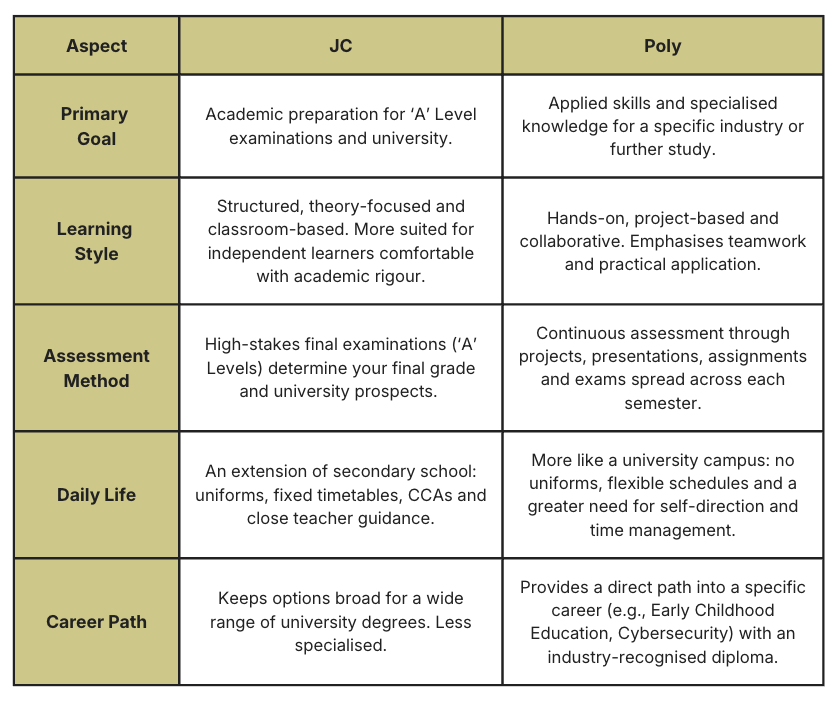
Beyond the surface, the two pathways offer fundamentally different educational experiences. The environment, assessment methods and daily life are worlds apart. To help my daughter visualise this, we broke it down into a simple table.
Is polytechnic really a 'second choice' to JC?
This is a persistent myth I've fought against for years. The data shows this perception is crumbling. The fact that nearly half of JC-eligible students are actively choosing a polytechnic path tells a powerful story. They are not 'settling' for poly. They are selecting it for its distinct advantages. Polytechnic educator Mrs. Anna Yap notes that understanding a child's learning style is paramount. For a student who is a hands-on learner, forcing them into a purely academic JC environment can be counterproductive, regardless of their ‘O’ Level score. The goal is to thrive, not just survive. A polytechnic education, with its emphasis on teamwork and practical problem-solving, builds skills that Singapore Polytechnic's PCEO, Mr. Soh Wai Wah, highlights as invaluable in the modern workplace.

Image Credit: Iewek Gnos
How do I know if my child is a 'poly kid' or a 'JC kid'?
This was the core of my conversations with my daughter. We put aside the noise and focused on who she is. Here is a simple checklist of questions we worked through. It might help you too.
How do they handle stress?
Do they perform best under the immense pressure of a single, final exam, or do they prefer spreading their effort out over a semester? Consistent workers often flourish with poly's continuous assessment.
Do they have a clear passion?
If your child is already passionate about animation, veterinary science or business analytics, a specialised polytechnic diploma can feel like a dream come true. As polytechnic principal Jeanne Liew advises, it's wise to explore the specific courses first, as polys design their own unique curricula.
How do they learn best?
Do they learn by doing, building and collaborating? Or do they prefer listening, reading and thinking through abstract concepts? There is no right answer, only what is right for them.
Are they ready for more independence?
The polytechnic environment demands a higher level of self-discipline. JC provides a more structured, familiar and supportive setting that extends the secondary school experience.

Image Credit: Dom Fou
The JC vs poly debate: What about university entry?
This is the big question for many parents. Let's be clear: JC has historically been the more direct path. Around 70% of each JC cohort secures a place in a local university. However, the pathway from polytechnic is wider than ever. A significant and growing number of poly graduates enter local universities. Many do so with module exemptions and advanced standing, recognising the depth of their diploma studies. The MOE's long-term strategy has been to increase the cohort participation rate in universities, and polytechnic graduates are a key part of that plan.
A parent's guide: My 3 steps for a calm conversation
Guiding your child through the JC vs poly choice doesn't have to be a battle. It's a partnership.
Step 1: Acknowledge your own bias.
Many of us grew up believing JC was the pinnacle. I had to consciously put that aside and listen to what the current landscape, and my own daughter, was telling me.
Step 2: Research the specifics.
Don't just talk about 'poly'. Explore the nearly 250 different diploma courses offered across the five institutions. We spent an afternoon on the websites of Ngee Ann Polytechnic and Temasek Polytechnic, and the sheer variety of options surprised even me.
Step 3: Ask, don't tell.
Instead of saying 'You should go to JC', I asked, 'What would an ideal day at school look like for you?' Instead of 'Poly is too specialised', I asked, 'Is there anything you're so curious about you'd love to study it for three years?' The answers will give you the clarity you need.
In the end, my daughter chose the path that excited her most. Seeing her engaged in projects she loves, and not drowning in a system that wasn't built for her, confirmed we made the right choice. Your child's journey is their own. Our role is to be their best-informed, most supportive guide.

Image Credit: George Pak
Frequently asked questions
Which is better after O levels, JC or poly?
The choice between Junior College (JC) and Polytechnic (Poly) is not about which is better, but about finding the right fit for a student's learning style, interests and aspirations. The article highlights that the 'default' path of JC is an outdated notion, with many high-achieving students now choosing polytechnics for their distinct advantages. The best of the two O level choices depends on whether the student thrives in a structured, academic environment (JC) or a hands-on, project-based one (Poly).
Is it harder to get into a local university from polytechnic?
While JC is historically considered the more direct path for university admission, the pathway from polytechnic is wider than ever, with a growing number of polytechnic graduates successfully entering local universities. The Ministry of Education (MOE) strategy supports increasing university places for polytechnic graduates, many of whom may even receive module exemptions in recognition of their specialised diploma studies.
What if I don't know what I want to do in the future, should I choose JC?
Junior College (JC) is often suitable for students who want to keep their university options broad, as its curriculum is less specialised and prepares students for the GCE 'A' Level examinations across a range of subjects. In contrast, a polytechnic path is ideal for students who already have a clear passion for a specific field, as they can dive deep into specialised polytechnic courses.
How is the learning style different in junior college singapore versus a polytechnic?
The learning style in a Junior College (JC) is structured, theory-focused and classroom-based, preparing students for high-stakes final 'A' Level examinations. In contrast, a polytechnic offers a hands-on, project-based learning environment with continuous assessment through assignments and group work, emphasising practical skills for a specific industry.
Is it true that only students who can't get into JC go to poly?
No, this is a persistent myth that is no longer accurate according to recent data from the MOE. The article states that in 2024, nearly half (49%) of students who were admitted to polytechnics were actually eligible for Junior College, indicating a deliberate choice to pursue a polytechnic education for its hands-on learning and specialised courses rather than it being a 'second choice'.
Find the Right Learning Support at Every Stage
Building strong study habits takes patience, especially when academic demands pick up. If your child needs an extra hand making difficult topics click, Geniebook offers targeted support across every stage. Find AI-personalised worksheets and live classes for primary and secondary school at Geniebook, comprehensive secondary, IB and JC subject tuition at AfterSkool or dedicated physics masterclasses at Tuition Physics and Best Physics Tuition.