
IBDP, A Levels and UK A Levels: A Comparative Overview

Image Credit: Lum3n
Choosing the right pre-university pathway is one of the most important academic decisions a student will make. In Singapore and many international schools, the most commonly compared options are the International Baccalaureate Diploma Programme (IBDP), Singapore-Cambridge GCE A Levels, and UK or International A Levels offered by boards such as Pearson Edexcel. While all three qualifications are globally recognised for university admission, they differ significantly in curriculum structure, assessment style, subject breadth, and learning approach. This article provides a simple, side-by-side comparison of IBDP, A Levels, and UK A Levels to help students and parents understand which programme may be the best fit for their academic goals and learning preferences.
1. What They Are
International Baccalaureate Diploma Programme (IBDP)
The IBDP is a two-year globally recognised programme designed to give students a broad, balanced education. It emphasises academic breadth and intellectual skills through coursework and examinations across six subject groups.
A Levels (Singapore-Cambridge GCE A Level)
A Levels are typically a two-year, subject-specialised qualification taken by students aged 16–18. In Singapore, the A Level certificate is awarded by the Singapore Examinations and Assessment Board (SEAB) in partnership with Cambridge. The programme allows students to focus deeply on a few chosen subjects.
UK A Levels / International A Levels (Edexcel, Cambridge etc.)
These are the A Levels offered under UK exam boards like Pearson Edexcel and Cambridge International. Recognised globally, they let students focus on three or four subjects, which are often broken into separate units or papers. Unlike the Singapore A Levels, some UK/International A Level units can be individually retaken.
2. Curriculum Design and Scope
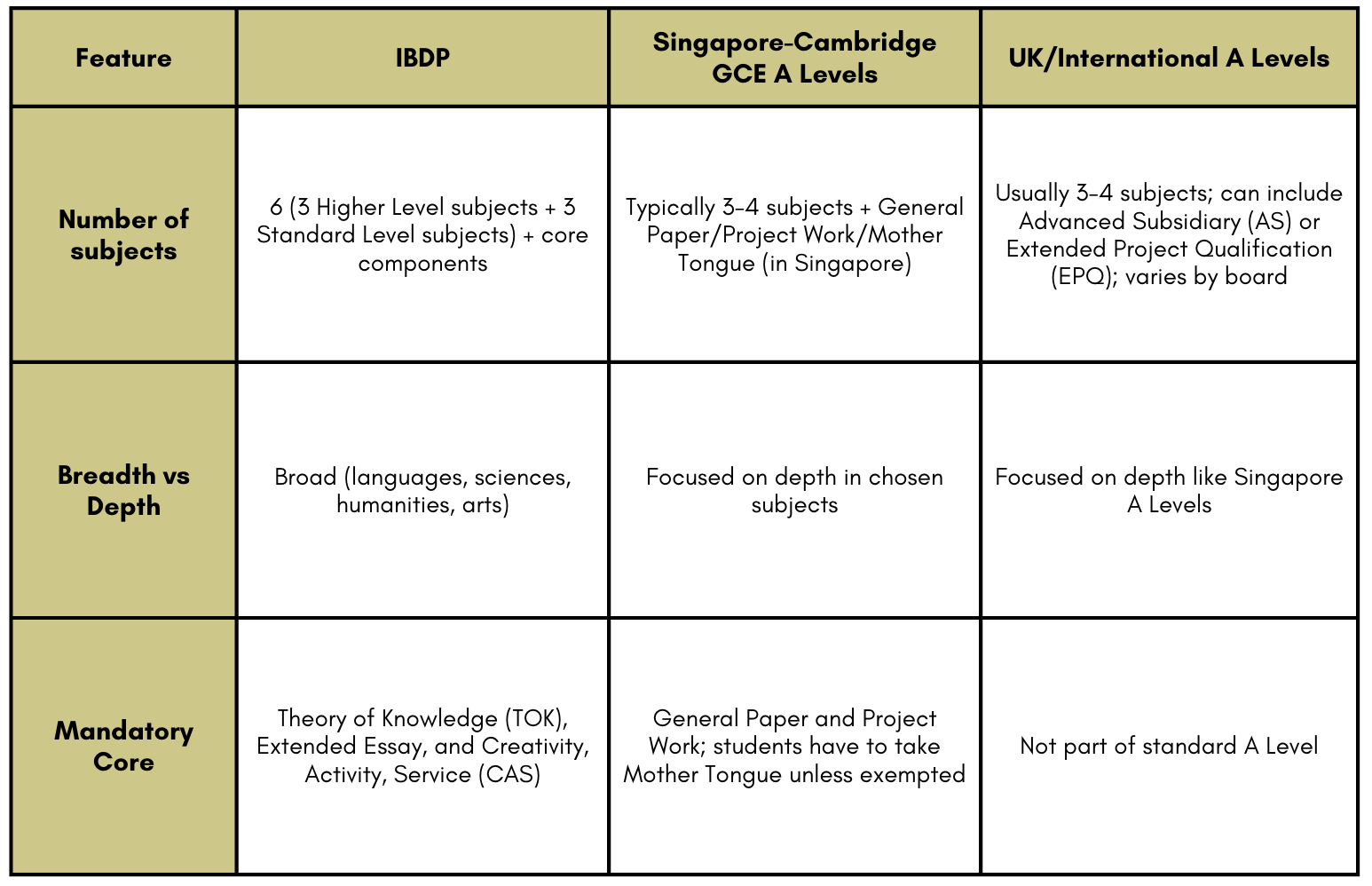
IBDP’s broader curriculum means students study across different disciplines rather than specialising immediately. A Levels, by contrast, let learners focus intensely on a smaller number of subjects.
3. Assessment and Grading
IBDP combines internal assessments (coursework, projects, teacher-graded work) with final written exams. Students are graded on a points system (maximum of 45).
Singapore-Cambridge GCE A Levels have terminal examinations at the end of the course, with grades awarded from A to E. Coursework elements (e.g. Project Work) support learning but final exams carry heavy weight.
UK/International A Levels are also largely exam-based and graded A* to E, with some boards offering flexible exam sessions and optional coursework/tracks. The IBDP’s assessment is seen as more holistic due to its mix of internal and external evaluation, while A Levels focus more on high-stakes final exams.
4. Educational Focus and Style
The IBDP is designed to build critical thinking, research skills, and global awareness through components like the Extended Essay and TOK. Students tackle a wide variety of subjects and are expected to manage independent work over two years.
The Singapore-Cambridge GCE A Levels emphasise specialisation and depth in subject areas of interest. Many students choose A Levels when they have a clearer idea of their future academic or career pathway.
The UK/International A Levels are similar in depth to Singapore A Levels, but some students perceive UK/International A Levels as slightly broader within each subject’s syllabus, and Edexcel qualifications are designed to be comparable internationally to UK standards.

Image Credit: Louis Bauer
5. University Recognition
All three qualifications are widely accepted by universities around the world.
The IBDP is well regarded for its breadth and research elements, often viewed positively for holistic preparation.
Both the Singapore and UK/International A Levels are particularly strong for specialised study and are traditional entry qualifications in the UK and many Commonwealth nations.
Edexcel and other UK boards ensure that International A Levels remain equivalent in standard to UK A Levels for global university admissions.
6. Choosing Between Them
IBDP might suit you if you want:
A broad curriculum spanning multiple disciplines.
Opportunities to develop independent research and writing skills.
A programme with coursework and internal assessment as part of the grade.
A Levels might suit you if you want:
To specialise early in subjects you are passionate about.
A curriculum focused on deep content knowledge and exam performance.
Flexibility to tailor your study load to fewer subjects, which can reduce weekly workload.
Align Your Choice with Your Learning Style and University Goals
The IBDP, Singapore-Cambridge GCE A Levels, and UK/International A Levels each have different strengths:
IBDP for breadth and skill development across diverse subjects.
Singapore-Cambridge GCE A Levels for specialist depth, and focus on final exams.
UK/International A Levels for internationally standardised subject focus and flexibility.
If you’d like to consult our experienced educators before making your choice, click here and we’ll be happy to help!