
IB Extended Essay (2027 Onwards): A Singapore Parent's Guide to Planning and Research
What is the IB Extended Essay?
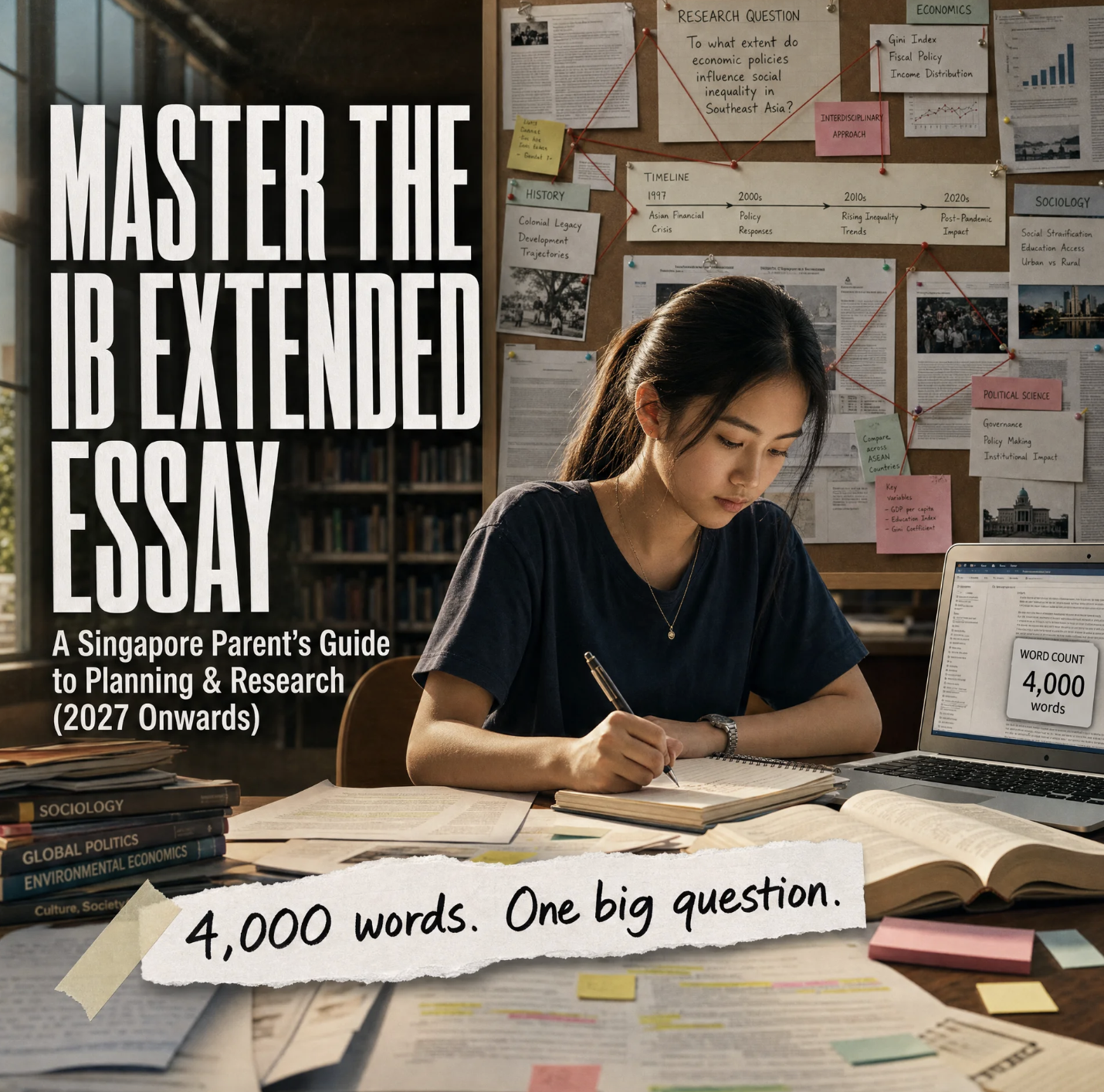
The IB Extended Essay (EE) is a mandatory 4,000-word independent research paper that forms a core part of the IB Diploma Programme. It is a significant undertaking designed to prepare students for university-level research, allowing them to deeply explore a topic that genuinely interests them. Together with the Theory of Knowledge (TOK) component, a strong EE can contribute up to three crucial diploma points.
Successfully completing the EE requires a D grade or higher. More importantly, it develops skills in critical thinking, independent learning and time management that are highly valued by universities. Key components include:
Independent Research: Students conduct their own investigation under the guidance of a school supervisor.
Formal Assessment: The final paper is externally assessed by an IB-appointed evaluator.
Reflection: Students must complete three mandatory reflection sessions with their supervisor, culminating in a final interview known as a "viva voce".

Image Credit: Budgeron Bach
What Are the Key Changes for the 2027 IB EE?
For students undertaking their first assessment in May 2027, the IB has introduced important updates to the Extended Essay. The new curriculum, launched in February 2025, aims to provide greater flexibility and clarity.
The most significant change is the introduction of two distinct research pathways:
1. A Subject-Focused Approach: A deep dive into a topic within a single DP subject.
2. An Interdisciplinary Approach: An integrated study that combines the lenses of two different DP subjects. This pathway formally absorbs the previous World Studies EE.
Additionally, the specific categories for Language A and Language B essays have been removed, streamlining the options for students focusing on languages.

Image Credit: Andy Barbour
How Should My Child Plan Their Extended Essay Timeline?
While the IBO does not set a global calendar, schools in Singapore establish their own internal deadlines. For instance, at Nexus International School (Singapore), the EE journey is a year-long process that typically begins in Term 2 of Year 12. This is a common structure across many IB schools here.
A successful project hinges on careful planning. A typical timeline involves these stages:
Topic Selection: Choosing a subject and a broad area of interest.
Formulating a Research Question: Narrowing the topic to a focused, clear and researchable question.
Research Planning: Outlining methodologies and identifying primary and secondary sources.
Writing Process: Structuring the argument and writing the 4,000-word essay.
Reflection and Viva Voce: Discussing the process and learnings with a supervisor.
What Makes a Good EE Research Question?
This is often the hardest part of the entire process. A weak question can derail the project from the start. The goal is to move from a broad topic like "The impact of AI on education" to a focused and arguable question like "To what extent has the adoption of AI-powered grading tools in Singapore's secondary schools since 2025 affected teacher feedback on English essays?"
Crafting a manageable and precise research question is a real challenge. School supervisors are an essential resource but their time is often split among many students. This is a specific point where some students falter, struggling to refine their ideas into a workable plan. Structured guidance through research-focused coaching can provide the dedicated feedback needed to sharpen a research question and build a solid project foundation.

Image Credit: Kaboom Pics
How is the Extended Essay Different from A-Level Coursework?
Many parents in Singapore are more familiar with the A-Level system. While the IB is often seen as having broader subject coverage, the EE represents a fundamental difference in educational philosophy. It is not simply a long essay. It is an exercise in independent academic inquiry.
Unlike A-Level coursework, which is often more structured, the EE places the student in the role of a true researcher. DP graduates consistently report that the skills they learned during the EE, managing a long-term project, thinking critically and conducting independent research, were invaluable in their transition to university. It is this emphasis on process and independent thought that sets the IB Diploma Programme and its extended essay apart.
Finding Support for the IB EE Journey
The EE is designed to be a challenging yet rewarding experience. Your child's school supervisor is their primary guide and support system. However, the independent nature of the project can feel daunting for both students and parents.
The key is to start early and stay organised. Maintaining a detailed research log, meeting deadlines and communicating openly with the supervisor can prevent the last-minute rush that compromises quality. For parents seeking to provide additional structure for their child's EE process, you can find out more about AfterSkool's dedicated Secondary, JC and IB tuition programmes.
Frequently asked questions
How many words does the IB extended essay need to be?
The IB Extended Essay is a mandatory 4,000-word independent research paper. This significant piece of work is a core requirement of the IB Diploma Programme and is designed to prepare students for university-level research.
What are the new changes to the IB extended essay from 2027?
The most significant change for the IB Extended Essay (IB EE) from the May 2027 assessment session is the introduction of two distinct research pathways: a subject-focused approach and an interdisciplinary one. This new structure, part of the curriculum launched in February 2025, replaces the previous system and formally incorporates the former World Studies EE into the interdisciplinary option.
How many points is the extended essay worth in the IB diploma?
The Extended Essay, when combined with the Theory of Knowledge (TOK) component, can contribute up to three diploma points to a student's final IB score. A student must achieve at least a D grade on their IB EE to be eligible for the diploma.
Can you give some examples of a good extended essay question?
A good extended essay question is focused and arguable, rather than broad. For example, a general topic like 'The impact of AI on education' can be refined into a strong research question such as, 'To what extent has the adoption of AI-powered grading tools in Singapore's secondary schools since 2025 affected teacher feedback on English essays?'. While this extended essay guide does not list specific biology extended essay examples or chemistry extended essay topics, the principle of narrowing a subject into a focused question is key for any student in the Singapore IBDP.
What is the difference between an IB EE and A-Level coursework?
The IB Extended Essay differs from A-Level coursework primarily in its emphasis on independent academic inquiry, placing the student in the role of a researcher. While A-Level coursework is often more structured, the IB diploma extended essay is a long-term project that develops skills in critical thinking and research management highly valued at university, a process which the extended essay IBO guide outlines in detail.
Find the Right Learning Support at Every Stage
Building strong study habits takes patience, especially when academic demands pick up. If your child needs an extra hand making difficult topics click, Geniebook offers targeted support across every stage. Find AI-personalised worksheets and live classes for primary and secondary school at Geniebook, comprehensive secondary, IB and JC subject tuition at AfterSkool or dedicated physics masterclasses at Tuition Physics and Best Physics Tuition.