
A-Level Practicals in 2027: Prep Plan with Structured Practice
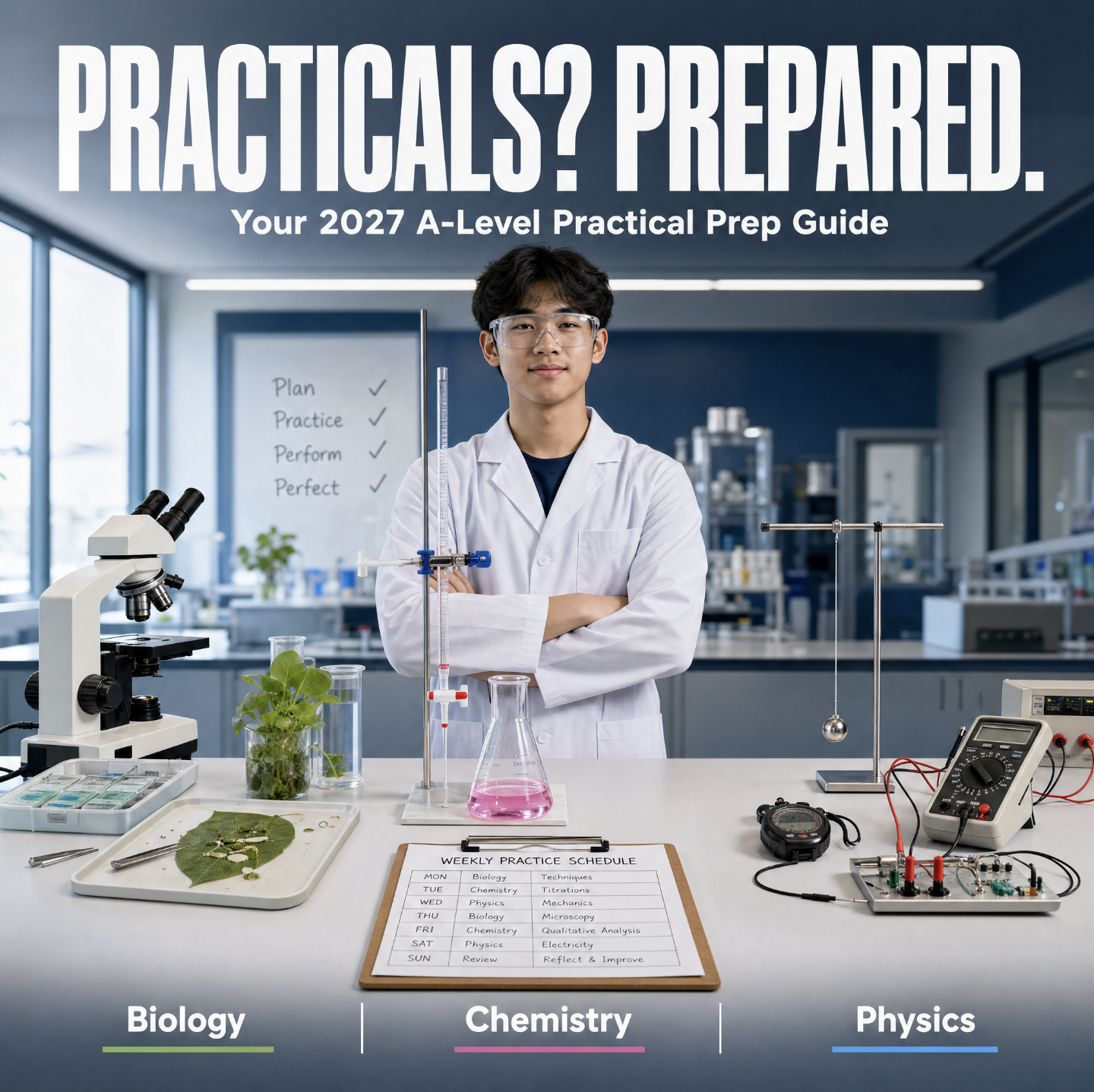
Success in the 2027 "A" Level practical exams hinges on a structured preparation plan that begins now in late 2026. These exams are a significant hurdle for university admission and require more than just theoretical knowledge. They demand sharp critical thinking, precise hands-on skills and sophisticated data analysis.
Even as MOE removes mid-year exams in JCs to reduce assessment load, the final "A" Level examinations remain as high-stakes as ever. For science students, the practical component is often the variable that makes or breaks their final grade.
Why have "A" Level practicals become so crucial?
Unlike some other qualifications there is no escaping the lab. For Singapore-Cambridge "A" Level sciences, the practical exam (Paper 4) and the Planning paper (Paper 1, for H2 subjects) are compulsory components. There is no “alternative to practical” paper to fall back on. This means every student must demonstrate proficiency in a live lab setting.
This isn't just about following a recipe. Examiners are looking for a deep conceptual understanding that connects theory to application. Can a student design a sound experiment to test a hypothesis? Can they identify sources of error in their own work and suggest valid improvements? This is a significant jump from the more guided experiments at "O" Levels.
Image Credit: Mikhail Nilov
What a “gold-standard” "A" Level practical prep plan looks like
A robust plan isn't about frantic last-minute cramming. It's a systematic process of building skills and confidence over time.
The timeline: When to start for the 2027 "A" Level exams
The ideal time to begin focused preparation for the 2027 "A" Level science practical is November 2026. Starting at the end of the JC1 year allows students to consolidate their learning and enter JC2 with a strong foundation. This early start transforms practical work from a source of anxiety into a familiar routine helping to build the muscle memory needed for tricky procedures like an aseptic technique in an "A" Level biology practical or a perfect titration in an "A" Level Chemistry practical.
The core components of practical mastery
Excellent performance rests on four pillars:
Hands-on technique: This is the fundamental ability to use equipment correctly and safely. It includes everything from handling a burette in chemistry to preparing a root tip squash practical for "A" Level biology or calibrating sensors for an "A" Level H2 physics practical.
Data analysis & evaluation: Collecting data is only the first step. Students must be able to process raw numbers, plot accurate graphs, calculate uncertainties and draw valid conclusions. This is a key focus of the practical papers.
Planning & experimental design: A major component of the exam requires students to plan an experiment from scratch. This tests their ability to think like a scientist: defining variables, selecting appropriate apparatus and outlining a step-by-step procedure.
Problem-solving under pressure: What happens when results are unexpected? Top students can troubleshoot in real-time, hypothesising reasons for anomalous data and adapting their approach. This skill is developed through repeated practice and exposure to varied scenarios.
How should my child balance school labs and external practice?
A common question from parents is whether school-based labs are sufficient. While JC teachers do an incredible job, a multi-pronged approach often yields the best results. Each method has its own strengths and potential gaps.
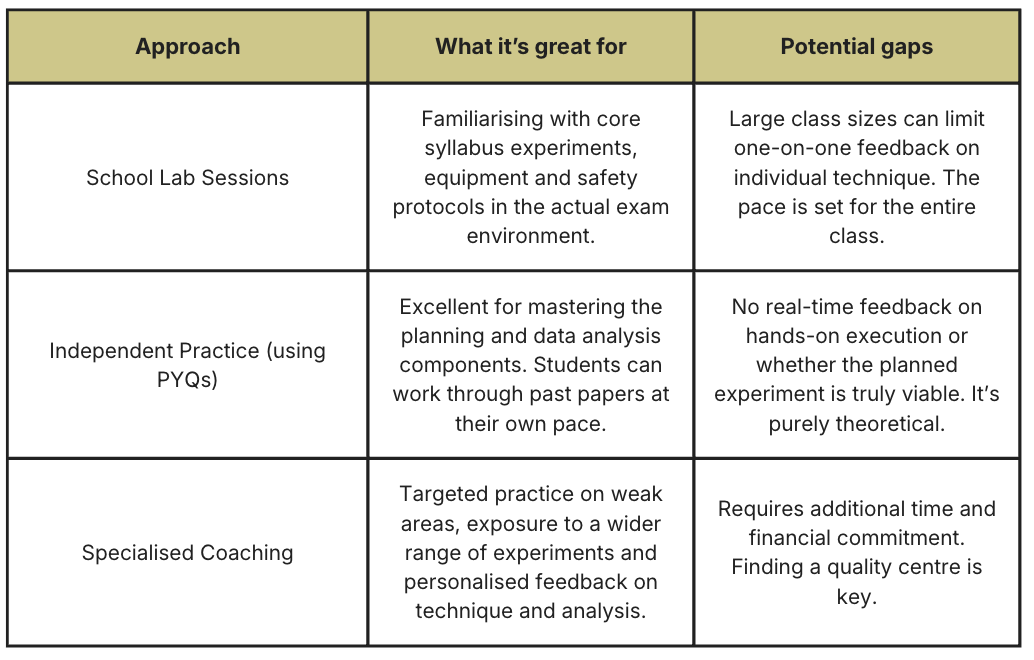
This is where many students feel a gap. They perform the steps in school but aren't sure if their technique is precise enough or if their data analysis would hold up under an examiner's scrutiny. Structured guidance from specialised coaching programmes can fill this gap by providing focused coaching and exam-specific feedback.

Image Credit: Mikhail Nilov
A practical checklist for your JC1 year (starting now)
To make preparation more concrete here is a simple checklist for students targeting the 2027 "A" Level practicals:
[ ] Verify your syllabus: Go to the SEAB website and download the latest syllabus for your H2 Science subject. Highlight all the sections related to practical skills.
[ ] Treat lab manuals like gold: Don't just follow the steps during school practicals. Actively understand why each step is necessary. Annotate your manual with your own observations.
[ ] Start a “mistake log”: After every practical session write down one error you made or observed. More importantly write down how you would prevent it next time. This active reflection is invaluable.
[ ] Practice planning questions: Use past "A" Level papers to practice the planning component. You can do this at your desk without any equipment. Time yourself.
[ ] Master one core skill at a time: Dedicate focus to mastering fundamental techniques. One week could be on drawing biological diagrams to the correct standard the next on calculating percentage uncertainty accurately.
Building confidence not just competence
Ultimately the goal of this structured approach is to build deep confidence. When a student has practiced the key techniques and thinking processes over many months the "A" Level science practical exam becomes less of a terrifying ordeal and more of an opportunity to demonstrate their mastery.
For parents exploring how targeted coaching can refine these practical skills you can find out more about specialised tuition programmes.
Frequently asked questions
When is the best time to start preparing for the 2027 A level practicals?
The ideal time to begin focused preparation for the 2027 A level practicals is November 2026, at the end of the JC1 year. Starting early allows students to consolidate their learning and build the muscle memory and confidence needed for complex procedures before the pressures of JC2 begin.
Are the Singapore A levels practical exams compulsory for science subjects?
Yes, the practical exam (Paper 4) is a compulsory component for all Singapore-Cambridge A Level science subjects. There is no “alternative to practical” paper, meaning every science student must demonstrate their skills in a live lab setting to complete their assessment.
What key skills do I need for A level practicals in subjects like biology and chemistry?
Success in A level practicals for subjects like biology and chemistry requires mastery of four key areas: hands-on technique, data analysis and evaluation, experimental planning and problem-solving under pressure. This includes everything from performing an A level biology practical procedure correctly to designing a sound experiment for an A level chem practical from scratch.
Are school lab sessions enough to prepare for my A level H2 physics practical?
While school labs are essential for covering the syllabus, they may not be sufficient on their own for preparing for an A level H2 physics practical due to large class sizes that limit one-on-one feedback. The article suggests that a multi-pronged approach including independent practice and specialised coaching can help fill potential gaps in technique and analysis that may not be fully addressed in a larger group setting.
How can JC tuition help with A level practical preparation?
Specialised JC tuition can help with A level practicals by providing targeted practice on a student's specific weaknesses and personalised feedback that might be difficult to receive in a large school lab. This focused coaching helps students refine their hands-on technique, improve their data analysis skills and gain exposure to a wider variety of experimental scenarios to build confidence for the exam.
Find the Right Learning Support at Every Stage
Building strong study habits takes patience, especially when academic demands pick up. If your child needs an extra hand making difficult topics click, Geniebook offers targeted support across every stage. Find AI-personalised worksheets and live classes for primary and secondary school at Geniebook, comprehensive secondary, IB and JC subject tuition at AfterSkool or dedicated physics masterclasses at Tuition Physics and Best Physics Tuition.